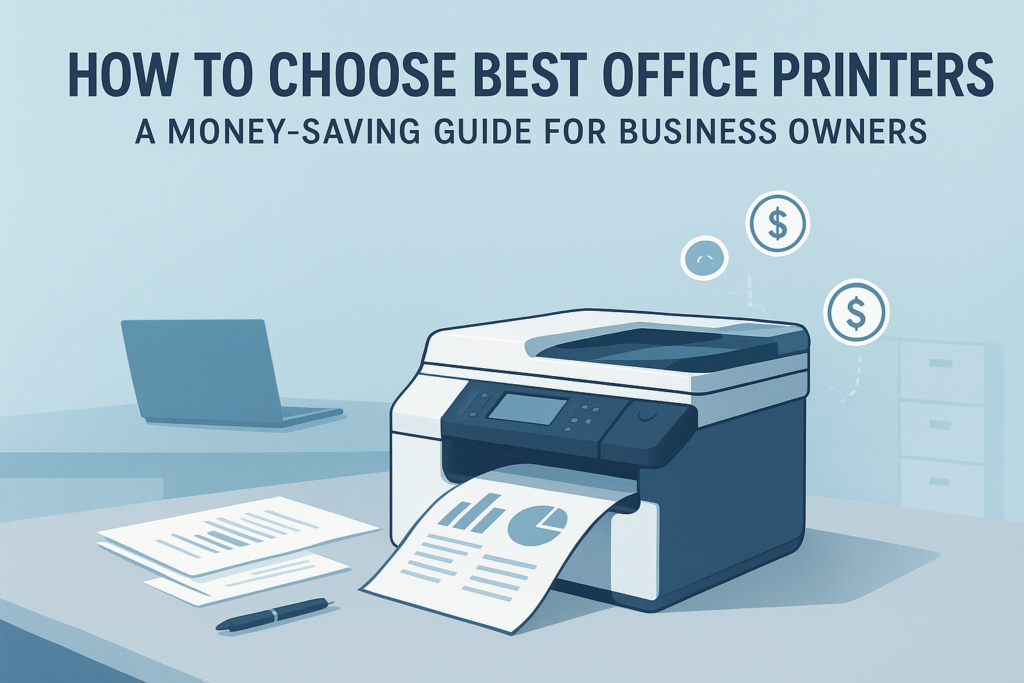
Did you know that companies lose up to 3% of their annual revenue on inefficient document management and printing costs? Picking the wrong printer for your workplace can silently drain your budget month after month.
Surprisingly, most business owners look at the initial cost when buying an office printer without considering the ongoing costs that determine its worth. The perfect office printer isn’t always the cheapest, nor the most expensive. If you want to find the best office printer for your business, the right choice depends on your specific workflow requirements.
This in-depth guide will show you the essential factors to think about when choosing an office printer that fits your business needs. We’ll cover everything from understanding how much you print and what types of documents you handle to figuring out the cost per page. This will help you make a choice that saves money now and in the future. Let’s discover what is the ‘best’ office printer and the right pick for your company.
1. Understand Your Business Printing Needs
To find out which is the best office printer for your business, first of all, you must analyze your organization’s printing requirements. Knowing your real print needs saves you from buying too little (which slows things down) or too much (which wastes money).
Assess daily and monthly print volume
How many pages you print affects which printer fits your business best. People in offices print about 7-8 times a day. Each worker prints about 10,000 pages a year (that’s like 1.3 trees).
To figure out how much your company prints:
- Keep track of what all your printers do for at least a month
- Look for busy times of year that might change how much you print
- Think about how your company might grow and need to print more
- See what different teams need
A full look at your printing shows your real costs and how much you print, so you can choose the right equipment. Also, monitoring software like FMAudit can track print volume and consumable levels, giving you valuable data for decision-making.
Identify document types: text, color, photos
Second thing that you need to be aware of is to know the type of documents you print as it is important to identify the kind of printer you need. Think about what your company prints:
Color prints cost 3-5 times more than black-and-white ones, and color graphics can push costs up to 60 cents per page. So, figuring out which teams need color printing can cut expenses—maybe by half or more.
Correspondingly, look at the types of paper you need to print. Some teams might need special stuff like cardstock, letterhead, or marketing materials, while others print normal text documents. Each kind of document affects what your office printer needs to do.
Consider number of users and departments
The number of employees using printers and where they are located influences your equipment needs. A deep look should cover:
- Who prints the most in your company
- When and how much each worker and team prints
- What programs they print from
Some teams have unique printing needs that call for specific solutions. For example, sales teams often need high-quality color prints for presentations, while accounting teams need lots of black-and-white prints. Legal, HR, marketing, and engineering teams also have their own special printing needs.
Optimizing printer placement and configuration can be achieved by having a thorough understanding of departmental workflows. By allocating codes to staff members or departments and permitting a predetermined quantity of copies each month, some organizations use user budgets to reduce printing expenses. This method makes it possible to monitor usage trends and spot areas where procedures could be streamlined.
In addition to guiding equipment purchases, a well-conducted print assessment identifies inefficiencies and contributes to a decrease in overall print volume. Through better management practices, many organizations find they can reduce printing costs by 40%, which eventually results in significant savings throughout your entire document ecosystem.
2. Choose the Right Printer Type
After understanding your business needs for printing, you should select the right printer type. Different printers are made to meet specific needs. For example, our printers use various technologies to suit different business requirements. Each type has its own benefits for certain kinds of businesses and their sizes.
Inkjet vs Laser: Pros and cons
Inkjet and laser are the two main types of printers you’ll find in offices. Each has its own strengths and drawbacks.
Inkjet printers spray small drops of liquid ink onto paper making them perfect for companies that value high-quality color prints. They are mostly used when it comes to creating eye-catching marketing materials and photo-realistic prints.
Following are the benefits of Inkjet printers:
- Top-notch color reproduction and photo printing skills
- Cheaper to buy than laser printers
- Quick to start up
- Small size that fits well in tight office spaces
Contrarily, inkjets cost more to run, with color printing expenses up to 3-5 times higher than black-and-white. Moreover, inkjet printers tend to be slower than laser printers and might produce “wet prints” that need time to dry.
Laser printers use toner powder and laser technology to create sharp images. This makes them the top choice for text-heavy documents and businesses that have high volume printing demand.
Following are the benefits of laser printers:
- Much quicker printing speeds
- Less cost per page when printing in bulk
- Sharper text quality and accuracy
- Printed documents last longer and don’t smudge
Conversely, laser printers cost more to buy, demand more physical space, and produce less impressive color quality than inkjets for photos and marketing stuff.
When to choose a monochrome printer
Monochrome (black and white) printers are often cost saving. These one-color machines work well in places that don’t need color printing, such as law offices, accounting teams, or admin departments.
Following are the benefits of Monochrome Printers:
- They cost much less per page than color printers
- They print faster than color models
- They’re easier to maintain because they have one ink cartridge
- They make sensitive papers more secure
Companies that print text, contracts, or reports can save a lot of money by using black and white printers as they don’t need color prints.
All-in-one vs single-function models
Choosing between multifunction printers (MFPs) and single-function printers plays a crucial role in making your office equipment work better.
Multifunction printers do printing, scanning, copying, and sometimes faxing, therefore they are also referred as “all in one” printers. These printers offer various solutions like:
- Less space is used as it combines many machines into one
- Cost saving when compared to buying separate equipment
- Easier maintenance with fewer devices to look after
- Less power use than running many machines
On the contrary, single-function printers focus only on printing tasks. They offer following benefits:
- Lower initial prices
- High-quality printing for specific work needs
- Better reliability because they have simpler parts
- Faster printing for environments that have high print volume
Many businesses use both types. They combine all-in-one devices in departments with diverse document needs. At the same time, they use special single-function printers for departments that need a lot of printing.
3. Evaluate Key Features That Impact Cost
The next step after selecting the printer type is to evaluate specific technical features that have direct effect on your ongoing operational costs. These factors often remain hidden but they have major long-term financial consequences for your company.
Print speed and duty cycle
Print speed, measured in pages per minute (ppm), impacts both cost effectiveness and productivity. Regular document speeds of business-grade printers range from 20 to 35 ppm, with higher-end models capable of up-to 35 ppm. In fast-paced environments where printing tasks must be finished quickly without sacrificing quality, this metric becomes even more important.
Another important aspect that is frequently disregarded when buying business equipment is the duty cycle. This amount represents the highest number of pages that a printer can consistently and reliably print each month. For example, small business laser printers usually have a monthly duty cycle of about 35,000 pages.
Despite these maximum ratings, experts advise:
- To ensure longevity, maintain regular usage at about 10% of the maximum duty cycle.
- Identifying what you really require considering business operations (for example, a 35,000 monthly duty cycle corresponds to roughly 1,667 pages per day during a normal 21-day work month).
An inadequate duty cycle for your needs will cause a printer to break down more quickly, resulting in increased maintenance expenses and an early replacement.
Paper tray capacity and media support
Paper tray capacity directly influences workflow efficiency. Regular office printers’ main trays can hold 250–500 sheets. The requirements can vary significantly, which depends on the print volume:
- Small offices: 100-250 sheet capacity serves usually
- Medium businesses: 500+ sheet capacity decreases fill-up rate
- High-volume environments: Consider models with additional high-capacity trays that can hold 3,000+ sheets
Similarly, paper type versatility also impacts cost and functionality. Business printers should offer:
- Various paper weights (typically 60-300 g/m²)
- Variety of media formats, such as envelopes, card stock, recycled paper, and letterhead
- Different paper sizes, ranging from letter/A-4 to legal and specialty formats
Buying a printer that accommodates your specific media needs avoids outsourcing or expensive workarounds.
Duplex printing and scanning options
Automatic duplex printing which has the capability to print on both sides of paper without manual intervention, offers substantial cost savings. The Environmental Protection Agency states that this feature can cut paper costs by 30 to 50 percent. Many businesses are unaware that, after payroll and rent, paper usually makes up the third-highest business expense.
Other than this, duplex printing offers more benefits, which are:
- Less storage space needed for printed documents;
- Cheaper shipping for materials sent by mail
- Less consumption means less of an impact on the environment.
For multitasking devices, automatic document feeders with duplex scanning capabilities increase productivity by automatically scanning both sides of multiple-page documents. This feature is particularly useful in business environments that have heavy paperwork, such as law offices, hospitals, or financial institutions.
The last aspect of cost consideration is energy efficiency. Energy Star-certified printers automatically transition to low-power modes when not in use, due to this, electricity consumption is reduced throughout the device’s lifespan.
4. Calculate Total Cost of Ownership
The upfront price of an office printer often represents just 5-15% of what you’ll actually spend over its lifetime. Understanding the total cost of ownership (TCO) helps prevent budget surprises and identifies which printer truly delivers the best value for your specific needs.
Cost per page: Ink vs toner
The cost per page metric reveals dramatic differences between printing technologies. Although inkjet printers typically have lower purchase prices, their ongoing expenses tell a different story:
- Inkjet printers average about 20 cents per page for mixed text and color printing
- Laser printers with toner average around 6 cents per page
This difference becomes substantial over time. For instance, a toner cartridge initially costs more (PKR 13,884-41,652) compared to ink cartridges (as low as PKR 4,165), yet the toner’s higher yield creates long-term savings. Consider these typical lifespans:
- Average ink cartridge: approximately 200-500 pages
- Average toner cartridge: 2,000-2,500 pages or more
Therefore, businesses printing more than 500 pages annually typically save money with laser printers despite their higher initial cost.
High-yield cartridges and refillable tanks
High-yield options offer substantial economies of scale for businesses with consistent printing needs. Standard toner yields around 2,500 pages, whereas high-yield cartridges can produce 5,000-10,000 pages per unit.
Refillable ink tank systems represent another cost-cutting alternative. These systems feature:
- Initial higher purchase cost offset by drastically reduced running costs
- Remarkably low cost per page (often less than 1 cent for black pages)
- Substantial ink volume included with purchase
For example, Canon’s refillable PIXMA G3260 offers black ink bottles priced at PKR 4,162 that yield approximately 6,000 pages—resulting in a cost per page of just PKR 0.69.
When comparing similar printers, a refillable tank model typically reaches cost parity with a traditional cartridge printer after around 4,000 pages. Beyond this threshold, the savings accelerate substantially.
Subscription ink services: Are they worth it?
Ink subscription services from major manufacturers offer an alternative approach to managing printing costs. These services monitor ink levels and automatically ship replacements before you run out.
HP’s Instant Ink subscription provides tiered monthly plans ranging from PKR 413 for 10 pages to PKR 7,772 for 700 pages. This translates to per-page costs between 11-41 cents depending on your plan.
The value proposition varies based on your printing habits:
- High-volume color printing generally benefits from subscriptions
- Predominantly black-and-white printing may be cheaper with traditional purchasing
- Infrequent printers might pay for unused pages
Moreover, these services provide conveniences beyond cost savings, including automatic delivery, simplified recycling, and elimination of emergency ink purchases.
For the best office printer selection, calculate your anticipated five-year TCO by adding purchase price, estimated consumable costs based on your volume, and potential maintenance expenses. This approach often reveals surprising differences between seemingly similar printer models.
5. Connectivity, Security, and Future-Proofing
Modern office printers offer numerous connectivity options that enhance productivity while maintaining document security. Selecting printers with the right connection features ensures your investment remains valuable as technology evolves.
Wi-Fi, Ethernet, and mobile printing
Contemporary printers support multiple connection methods to accommodate diverse workplace environments. Wi-Fi connectivity provides flexibility for device placement and enables printing from anywhere within network range. Alternatively, Ethernet connections deliver more reliable, stable performance ideal for high-volume printing environments. Many businesses implement both options to maximize versatility.
Mobile printing capabilities have become essential as workforces grow increasingly mobile. Most major manufacturers offer dedicated mobile apps that allow employees to print directly from smartphones and tablets. These applications support printing from virtually any location when connected to the internet.
Cloud printing and remote access
In addition to traditional connectivity, cloud printing services enable employees to print documents from anywhere, significantly enhancing productivity for remote and hybrid teams. Solutions like Microsoft Universal Print eliminate complex on-premises infrastructure while providing centralized management through cloud portals.
Remote access features further support distributed workforces by offering:
- Email-to-print functionality for simplified document submission
- Secure pull printing that holds jobs until user authentication
- VPN access options for environments requiring direct connections
Security features for shared office printers
Above all, security remains crucial for business printers. According to Quocirca, 68% of organizations have experienced data loss due to unsecured printing practices. Modern printers address these vulnerabilities through:
- User authentication methods (PINs, cards, biometrics) prevent unauthorized access to sensitive documents.
- Meanwhile, data encryption protects information during transmission through secure protocols like IPSec and SSL/TLS.
- Advanced printers also include automatic firmware updates and zero-trust security models designed to safeguard your network’s vulnerable endpoints.
Conclusion
Selecting the right office printer represents a significant decision that affects your bottom line for years to come. The perfect printer balances initial investment against long-term operational costs while meeting your specific business requirements.
Most importantly, understanding your actual printing needs forms the foundation of a cost-effective decision. Careful assessment of print volumes, document types, and user requirements prevents both costly over-purchasing and productivity-hindering under-purchasing.
The printer type you choose—whether inkjet or laser, monochrome or color, multifunction or single-purpose—should align with your documented requirements rather than following general recommendations. Similarly, technical specifications like duty cycle, print speed, and paper handling capabilities directly impact both productivity and operational costs.
Beyond the purchase price, the total cost of ownership ultimately determines the true value of your investment. Consequently, calculating expenses across the printer’s entire lifecycle reveals which option delivers genuine cost savings for your specific situation.
Additionally, connectivity options and security features ensure your printer remains valuable as your business evolves. Modern cloud printing capabilities and robust security protocols protect both your network and sensitive documents while supporting increasingly mobile workforces.
The best office printer for your business balances all these factors against your specific needs and budget constraints. Through thoughtful analysis and strategic decision-making, you can transform printing from a drain on resources into an efficient, cost-effective business tool that supports your operations for years to come.